
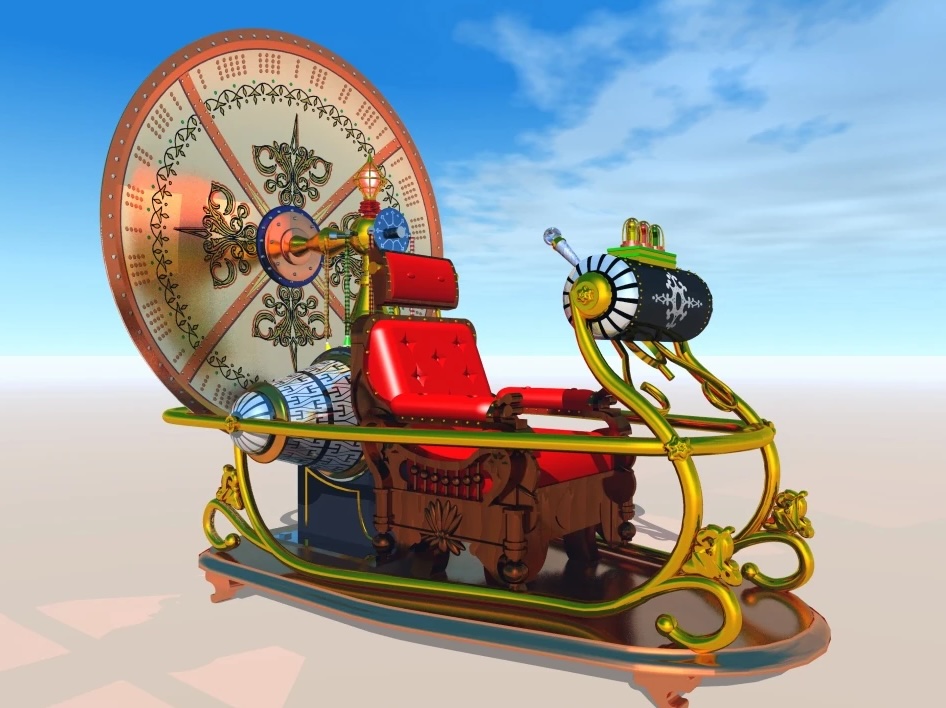
Time Flies
The Time Machine, by H.G. Wells, was not the first literary work involving time travel. Not by a long shot. The Mahabharata, one of the great Sanskrit epics from India, includes a story of King Kadhumi, who leaves his earthly realm and visits Brahma. After listening to celestial music, the King returns home to discover that many centuries have passed. Oral versions of this story are believed to date back well before the Common Era.
Numerous other ancient tales – from Japan and the Middle East, for example – also involve characters experiencing radical shifts in chronology, tropes that more modern authors employed in such works Rip Van Winkle and A Connecticut Yankee in King Arthur’s Court.
The 1895 novel by H.G. Wells, from which we drew the quote in this week’s acrostic, is probably the first to feature a mechanical device in which someone can intentionally travel through time and can control, at least to some extent, how far into the future or the past to go. And whoever came up with the version of that device used in the 1960 film of The Time Machine and pictured above had a stroke of brilliance, in our view.
The genre of time travel has grown explosively since 1895, perhaps aided by Albert Einstein and others who taught us about the space-time continuum and offered us the counterintuitive notion that time can move at different speeds and proceed in other strange ways. (If any of you can explain these concepts to us in sixth-grade terms, please feel free.) That growth in the time travel genre provided us with lots of fodder for thematic clues and answers. Which ones are your favorites?
One of our favorites – alright, one of Dave’s favorites – appears as Answer I and in this iconic video:
Another book I discovered through the Acrostic. The others i discovered, and enjoyed, were much more recent. I’m looking forward to this one.
Wow! What a great Acrostic. Always loved words like P. which connoted something truly positive until it came to mean positively negative.
Time and Again, by Jack Finney, makes you believe that it is possible to swap time periods.
Really fun, as always. I actually found the definitions more challenging than usual. But Clue C gave a strong hint as to what was up, since the novel was not named and quite familiar to me. Once I had the author and name of the book, the rest fell pretty easily.
The Time Machine is a wonderful and terrifying fiction. It’s no wonder it’s been the spiritual inspiration for subsequent fiction, movies and books, for the last 130 years.
Apart from the obvious time travel clues (C., I, J. Q), I detected a few somewhat more subtle ones. B: Scrooge has visions of his woeful past that transform him; M: Martha Jones regularly accompanied the Tenth Doctor in time-travel; O: So does Mrs. Whatsit time-travel in A Wrinkle in Time; and T (“night and day“). A benign song title becomes horrifying in the context of The Time Machine. The evil Morlocks only emerge from their underground caverns at night, to feast on the poor, defenseless Eloi people.
Great job, Greg, identifying all those thematic answers. In addition, there’s Clue A (“A Connecticut Yankee” being another fun time-travel novel) and, more tangentially, Answer L (“in transition,” a temporal process and one certainly experienced by a passenger on the Time Machine), Answer U (“end date,” with its clue referencing a “time period”) and the allusion to time in Clue R, with watches.
Will Shortz told us his all-time favorite book as a youth was “The Time Machine.”
I love that early steampunk design! Makes me want to see the film again. And it’s on TCM this week, Tuesday!
I had only 4 answers on first pass and briefly despaired. But those 4 answers gave me THE MYSTERY and STRANGE and a few THEs, which drew me on to grasp the theme and get through the puzzle. A very fun one!
Great puzzle! Most of the clues would have been too challenging for me … but I happened to know A and ~guessed at B. Then “H G” where the author’s name would appear suggested it must be Wells; and when I tested “The Time Machine” for the book title I had enough hits to believe it. In short, then, I quickly and luckily had the first letter of every clue, so was able to surmount my ignorance by slow back-and-forth from the quote to the clues. Thank you for celebrating this wonderful story and adding the resonance of several other beloved sources (Twain, L’Engle, Dr. Who)!
This one was right up my alley as I was sci fi nerd as a kid and had read The Time Machine, A Connecticut Yankee . . ., A Wrinkle In Time, and (although not sci fi) A Christmas Carol. And, as an elderly soccer nerd, TRAFFORD was a gimme for me. Despite my familiarity with so many clues, the puzzle was chewy enough to be fun.
This was a challenging one for me; I’ve managed the last few Acrostics “closed-book,” if you will, but when I ran head-on into name-clues like M, H, and C, I knew I’d have to turn to the Internet because I’ve never been good at remembering character names. But the quotation was a wonderful H.G. Wells excerpt; like others here, it has inspired me to revisit his books because I’d forgotten how — well, “awfully” lyrical his writing is. 😉